


Here's a fact to drop in your group chat: the most valuable AI company on Earth right now is not OpenAI. It's Anthropic, the company behind Claude, and as of late May 2026 it's worth a frankly absurd $965 billion (CNBC).
The catch? You can't buy a single share of it on your brokerage app. Same goes for SpaceX, OpenAI, and most of the other names on this list. They're private. That's exactly why people are obsessed with them.
"Pre-IPO" just means a company that hasn't sold shares to the public yet. And a handful of these private giants have been compounding in value faster than almost anything on the actual stock market. Below is the watchlist: seven of the most talked-about pre-IPO names in 2026, ranked biggest to smallest. For each one you get the plain-English version, what it does, what it's worth, and whether it's actually heading for an IPO. At the bottom, we get into how regular people are now getting exposure to all seven on-chain, 24/7, without an accredited-investor badge.
Quick reality check before we dive in: this is an educational watchlist, not financial advice. Private valuations swing hard and carry real risk. Treat every number here as a snapshot, because by next quarter half of them will have moved.
The watchlist at a glance
1. SpaceX: the rocket company that's finally going public
For years, SpaceX was the textbook "company you wish you could invest in." In 2026, that wait basically ended. Elon Musk's rocket-and-Starlink empire filed a Form S-1 with the SEC on May 20, 2026, applying to list on Nasdaq under the ticker SPCX (SEC).
The numbers are wild. Reports peg the target valuation between $1.75 trillion and $2 trillion, which would make it one of the largest IPOs ever. For context on how fast it got here: an insider share sale in December 2025 valued the company at around $800 billion (CNBC). So it roughly doubled in months. Starlink does most of the heavy lifting on revenue, and crucially, around 30% of the IPO is reportedly earmarked for retail investors. SpaceX is the one name here actively crossing from private to public, so it may not stay "pre-IPO" for long.
2. Anthropic: the startup that came out of nowhere and passed OpenAI
This is the headline of the whole list. Anthropic makes Claude, the AI assistant that goes head-to-head with ChatGPT. In May 2026 it raised a $65 billion Series H at a $965 billion post-money valuation, led by Altimeter, Dragoneer, Greenoaks, and Sequoia (Anthropic). That officially made it the most valuable AI startup on the planet, nudging past OpenAI.
Now sit with the timeline. Anthropic's valuation nearly tripled from $380 billion earlier in the year. Its run-rate revenue reportedly crossed $47 billion. Its backers include Amazon and Google. And the press widely treats this as possibly its last private round before going public. For a company most people had barely heard of two years ago, that's a stunning run, and the clearest example of how fast (and how unpredictably) private AI valuations move.
3. OpenAI: still the household name, now playing catch-up
OpenAI is the company behind ChatGPT, the app that introduced the world to generative AI. It closed a record $122 billion funding round at an $852 billion valuation in late March 2026, its biggest raise ever, with reported backers including Amazon, Nvidia, and SoftBank (Bloomberg).
Here's the twist nobody saw coming a year ago: it's now the second most valuable AI lab, behind Anthropic. OpenAI also has an unusual setup, with a nonprofit foundation sitting on top of the for-profit business, which is worth understanding before you treat it like a normal startup. An IPO has been hinted at in the press but nothing's been filed. Either way, it's still one of the most sought-after private companies alive.
4. xAI: Elon's other AI bet that quietly swallowed Twitter
Yes, Musk shows up twice on this list. xAI builds Grok, the AI wired straight into X, and in 2025 xAI actually acquired X itself. In January 2026 it raised $20 billion in an upsized Series E, which the company framed as a potential valuation above $230 billion (xAI; TechCrunch). Reported investors include Fidelity, the Qatar Investment Authority, Nvidia, and Cisco.
The pitch is simple and a little terrifying for competitors: xAI is a frontier AI lab with a giant social network bolted on, which means built-in distribution most startups can only dream of. No IPO is on the table yet. And note xAI's own wording calls the $230 billion a "potential" figure, not a fixed price, so treat it as a strong signal rather than gospel.
5. Anduril: the defense startup that flat-out says it will IPO
Anduril, co-founded in 2017 by Oculus creator Palmer Luckey, builds autonomous weapons and the software that runs them: drones, counter-drone systems, even uncrewed submarines. In May 2026 it raised a $5 billion Series H at a $61 billion valuation, led by Thrive Capital and Andreessen Horowitz, roughly doubling its worth in under a year and setting a record for the largest defense-tech round ever (TechCrunch).
What makes Anduril stand out is the IPO clarity. Luckey has said the company will "definitely" go public, arguing you basically can't win the biggest defense contracts while staying private (CNBC). No filing or date yet, but the intent is unusually blunt for a private company. If you want a non-AI name on a very AI-heavy list, this is it.
6. Kalshi: the betting market the government actually approves of
Kalshi runs a US-regulated exchange for "event contracts," basically yes-or-no bets on real-world outcomes like economic data, elections, and sports. Its whole edge is that it's legit: it operates under CFTC oversight, which separates it from offshore or crypto-only rivals. A 2026 Series F led by Coatue valued it at $22 billion, with Sequoia and Andreessen Horowitz joining in (Kalshi).
Like everything else here, the growth has been explosive, with its valuation roughly doubling from the prior round months earlier. No IPO announced. For a retail investor, Kalshi is essentially a bet on prediction markets going mainstream inside the US regulatory system rather than around it.
7. Polymarket: the crypto prediction market the NYSE's owner just bet on
Polymarket is the crypto-native cousin of Kalshi. Founded in 2020 by Shayne Coplan, it lets users trade shares tied to future events across politics, sports, and culture, settled peer-to-peer on the blockchain. In October 2025, Intercontinental Exchange (ICE), the company that owns the New York Stock Exchange, announced a strategic investment of up to $2 billion, implying a valuation around $8 billion (ICE).
When the owner of the NYSE writes a check that big to a crypto prediction market, that tells you how fast this category has gone mainstream. No IPO announced. It's the smallest valuation on the list, which optimists read as the most room to grow and skeptics read as the most risk. Probably both.
So why can't you just buy these?
Here's the frustrating part: you normally can't. In the US, most private offerings are restricted to accredited investors, meaning people who clear high income or net-worth thresholds. If you don't qualify, your usual options are indirect and clunky: pre-IPO marketplaces like EquityZen and Forge that gate access and charge fees, the occasional brokerage that dabbles in private shares, or funds that hold tiny slices of these companies. The XOVR ETF from ERShares, for example, holds SpaceX indirectly through a special-purpose vehicle (ERShares).
Those routes work, but they all share the same trade-offs: you usually can't pick the specific company or price, you eat fund or platform fees, and your exposure to any single name gets diluted across a whole basket. Getting clean, direct-feeling exposure to one specific pre-IPO name has basically been a pain.
The plot twist: pre-IPOs are now on-chain
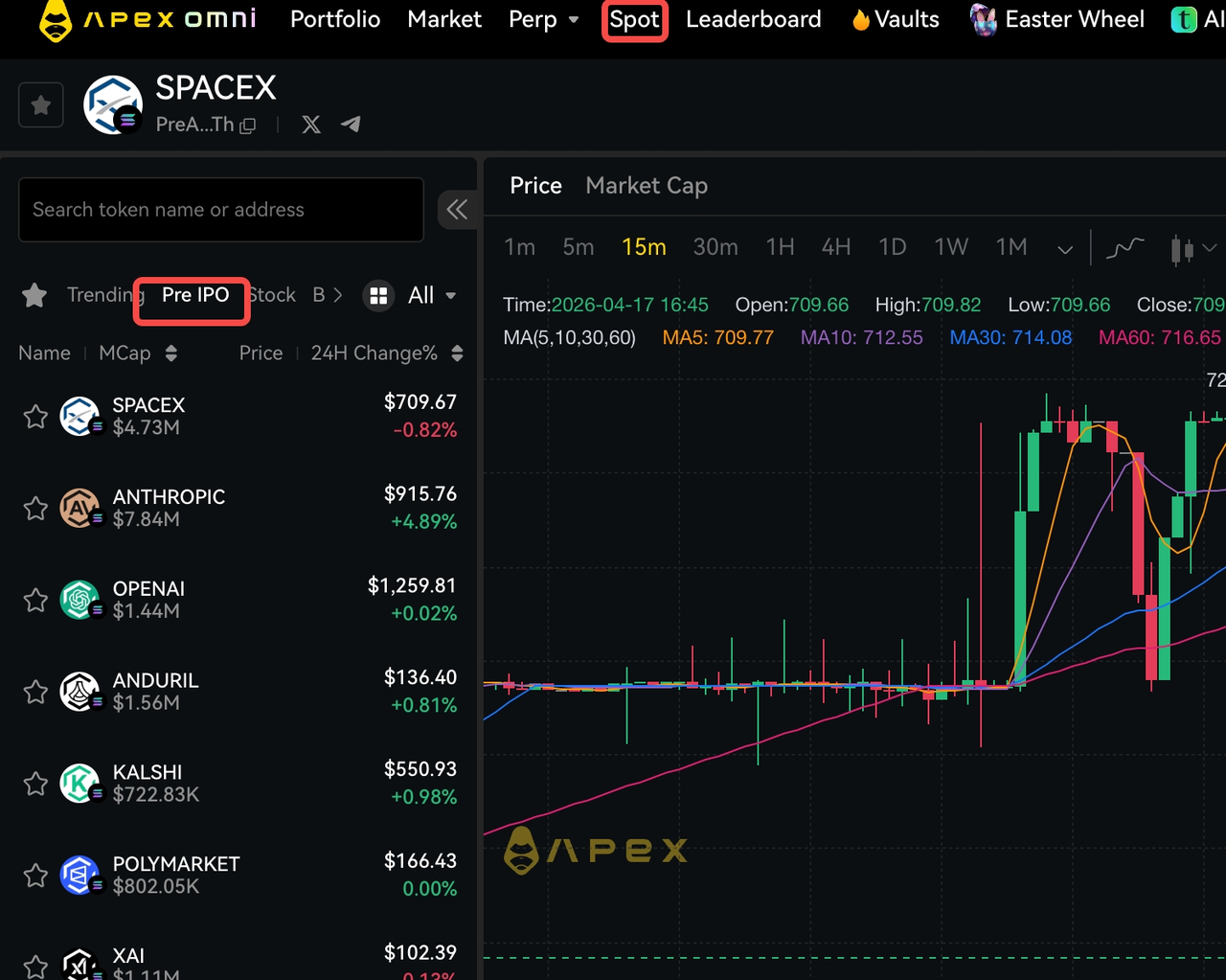
This is where it gets interesting. ApeX Omni offers a Pre-IPO Spot product that lets you trade tokenized assets tracking the valuations of private companies, on-chain, before they ever list. And the lineup maps almost perfectly to this watchlist: SpaceX, Anthropic, OpenAI, Anduril, Kalshi, Polymarket, and xAI are all available as pre-IPO tokens (ApeX Omni).
In plain terms:
What you're buying: tokens issued by a provider called PreStocks, designed to give economic exposure to a company's valuation movements without waiting for a public listing. They're backed by entities that invest directly or indirectly in the underlying companies.
How the price stays honest: an arbitrage mechanism keeps each token aligned with the real-world valuation. If it drifts too high or low, traders are incentivized to mint, sell, or redeem until the gap closes.
What happens at IPO: if the company goes public or gets acquired, the underlying position is liquidated and proceeds convert to USDT. If neither happens, the tokens just keep trading.
The mechanics: on-chain, settled in USDT, no-bridging no-swapping needed, 24/7, no lock-up.
How to buy a pre-IPO token on ApeX Omni, step by step:
Open ApeX Omni and connect. Go to omni.apex.exchange and either connect a crypto wallet (MetaMask, Trust Wallet, Rabby, OKX, Phantom, or almost any wallet via WalletConnect) or sign up with just an email, which generates a wallet for you automatically. Creating an account is free, needs no gas, and requires no KYC for standard wallet-based trading (Onboarding Guide).
Fund your account with USDT. Deposit USDT from an external wallet or a centralized exchange. ApeX Omni supports deposits across several networks, including Ethereum, BNB Chain, Base, Arbitrum One, and Mantle, and it lets you swap another token (such as ETH) into USDT during the deposit if you need to (Deposit Guide).
Go to the Pre-IPO market. From the Spot Swap page, open the Pre-IPO section. You'll see the available tokens: SpaceX, Anthropic, OpenAI, Anduril, Kalshi, Polymarket, and xAI.
Pick a token and place your order. Select the company you want, enter your position size in USDT, and confirm. The token settles on-chain and appears in your portfolio right away.
Hold or sell whenever you like. There's no lock-up and no minimum holding period, so you can sell back to USDT at any time. If the company eventually IPOs or gets acquired, the underlying position is liquidated and the proceeds are paid out in USDT.
One thing you absolutely need to know: Pre-IPO tokens do not represent actual stock ownership. Holders have no voting rights, dividend entitlements, or shareholder privileges. Trading Pre-IPO tokens involves market risk, liquidity risk, pricing mechanism risk, and issuer adjustment risk. Read the full docs before you trade so you know exactly what you're holding.
The bottom line
SpaceX, Anthropic, OpenAI, xAI, Anduril, Kalshi, and Polymarket are some of the fastest-growing companies of this era, and for years they were nearly impossible for everyday investors to touch. Venture-style ETFs cracked the door open. On-chain products like ApeX Omni's Pre-IPO Spot now offer a more direct, 24/7 way to get exposure to a specific name.
Just don't forget the trade-off hiding under all that upside. These valuations can double in months, and they can drop just as fast. Whether you go through a regulated fund or an on-chain token, size your position to what you can actually afford to lose, and understand exactly what you're buying before you click buy.
This article is for educational and informational purposes only and is not financial, investment, or legal advice. Pre-IPO assets and tokenized products are high-risk and may be restricted in your jurisdiction; tokenized pre-IPO products do not confer share ownership. Valuations and funding details cited are accurate to the dates and sources noted and change rapidly. Do your own research and consult a licensed professional before investing.